
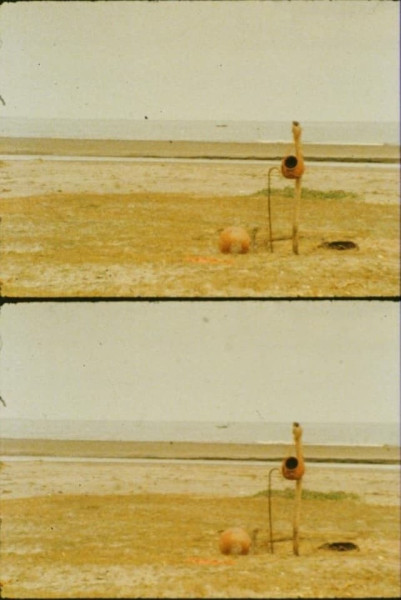
In Ganga, painter-filmmaker Velu Viswanadhan traces the sacred river from the Sagar island estuary to its Himalayan source, weaving together everyday life, myth and poetry into a flowing cinematic journey.
GANGA (WATER)
VELU VISWANADHAN — IN, 1985 – 16MM – 153’
“A flowing cinematic journey”
Arindam Sen
| 05/12 | 20:00 | Projectvierennegentig | Ostend |
Between 1976 and 2002, Paris based painter Velu Viswanadhan embarked on a series of five films in India about the elements that form the material basis of the universe (Earth, Water, Fire, Air, and Ether) according to the ancient Vedas. Ganga (Water) is the second film in this pentalogy where Viswanadhan traveled upstream along the Ganges River, setting out at Sagar Island in Bengal (at the confluence of the river and the Bay of Bengal ocean) and traveling to its origin at Gomukh in the Himalayas.
The film is a sensorial exploration of life that prospers on the shores of the most significant river of the Indian subcontinent – its civilizational lifeline. At various points we encounter shots of religious rituals, architecture, fishing, craftsmanship – each of them autonomous and self-fulfilled, without feeding into an overarching narrative – documentary shots that bestow poetry to the mundane.
On the soundtrack we hear singing, chanting, and field recordings that densify our reception of the image. The film evokes history and philosophy, myths and poetry, murmurs of the past resonating through the life on the coast and pointing to its perpetuity, always alert to its transformations over the ages but without any romantic allusions.
Viswanadhan spent his formative years in the 1940s in Kerala and belonged to a family of Visvakarmas (a Hindu mythological concept with Upanishadic roots meaning “architects of the world”) who were potters, blacksmiths, and sculptors.
Between 1976 and 2002, Viswanadhan made a series of five films in India about the elements that form the material basis of the universe (Earth, Water, Fire, Air, and Ether) according to the ancient Vedas. These films combined the artist’s unwavering observational and non-intrusive documentary interest in religious rituals and mechanical labor with a painterly interest in landscapes.
(Arindam Sen)
~ ~ ~
With the support of Vlaams Audiovisueel Fonds and KAAP.
A program curated by Arindam Sen.
SUPPORT — Your support is more than welcome and literally brings light to the screen:
BE80 7340 4532 5277 BIC: KREDBEBB
Payment reference: ‘Gift’.
Gifts above the sum of € 40 are tax deductible.
A gift of € 100 will only cost you € 55.
Artistic coordination: Anouk De Clercq, Godart Bakkers
General coordination: Ditte Claus
Artistic team: Eric de Kuyper, Xavier Garcia Bardon
Production team: Bob Mees, Jef Declercq, Johan Opstaele, Noah Heylen
Communication: Cynthia Vandenbruaene
Graphic design: Michaël Bussaer. Webdesign: Dominique Callewaert.
With the support of Auguste Orts, CINEMATEK, KAAP, KASK School of Arts Gent, Onderzoeksfonds Universiteit Gent, Vlaams Audiovisueel Fonds, Vlaamse gemeenschap.

Whoever walks in Ostend today is confronted with a fantastic eclecticism: a brutal grey apartment block exists next to the glorious Thermae Palace. The mighty, almost Stalinist, building of De Grote Post dominates the Hendrik Serruyslaan. A former department store houses a museum for contemporary art. Belle-époque houses are hidden in the quiet but stately streets.
In 2017, one void struck artist Anouk De Clercq: that glorious film culture of Henri Storck, James Ensor or Raoul Servais had disappeared from the streets. With the closure of the Rialto cinema, the last independent cinema from the Ostend cinema circuit also disappeared. Against such an extraordinary backdrop, with the sea as a large projection surface for images, stories and histories, that is such a shame.
And so the idea of Monokino ripens: one room, marked by an equally fantastic eclecticism, where cinema can be itself again. One room where long and short films, film classics, auteur cinema, video art, experimental films, animation, or the work of young makers can find a place. Monokino shows, questions, responds, engages in conversation, invites, welcomes, puts in perspective. Monokino is a place of, by and for people from Ostend, for professionals and enthusiasts, for young and old, for those from here and those from there.
The films that Monokino wants to show don’t only live on the screen. They also spread between residents, spectators, and makers. In that sense, Monokino is also Kopfkino: a mental cinema, where images get the chance to live and multiply.
That’s how Monokino drifts nomadically through those eclectic streets of Ostend and settles in the heads and hearts of the people of Ostend. Soon it’ll moor for good.
Monokino wants to drive cinema into the 21st century and illuminate the adventurous side of film. While we strive for a permanent place as anchorage for cinefiles from Ostend and beyond, Monokino operates as a nomadic film platform.
The sea is Monokino’s favourite projection surface for images, stories and histories. In anticipation of our next screening, we’ve started to collect a list of films in which the sea plays a main or supporting role. Can you think of a film that’s not already on our list? We’d love to hear about it via info@monokino.org.