
Two women, two eras, one sea that connects everything.
In the presence of Nina de Vroome and the spirit of Agnès Varda.
LA POINTE COURTE
AGNES VARDA — FR, 1955 – 86’
EEN IDEE VAN DE ZEE
NINA DE VROOME — BE, 2016 – 61’
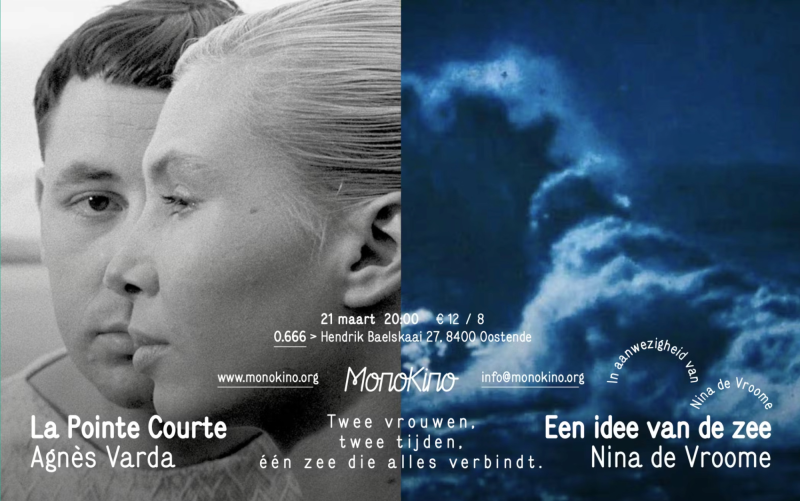
| 21/03 | 20:00 | O.666 | Ostend |
Long before the success of Les 400 Coups by François Truffaut, À bout de souffle by Jean-Luc Godard, and Hiroshima, mon amour by Alain Resnais (the editor of La Pointe Courte), Agnès Varda —a self-taught filmmaker—took pioneering first steps toward the Nouvelle Vague in a fishermen’s district of Sète: a young, fresh wave in French cinema that set itself against the traditional “cinéma de papa.”
With La Pointe Courte in 1955, Agnès Varda pushed the boundaries of cinematic realism. In the eponymous fishing village on the Mediterranean, she captures the daily lives of its inhabitants with an almost documentary precision. At the same time, she follows a young couple struggling with their relationship, allowing personal and collective stories to merge in a poetic way.
With an eye for detail, natural light, and the rhythm of everyday life, she shows how people and the sea, work and love, constantly influence one another. La Pointe Courte is an intimate and lyrical portrait of a community, and one of the most original and inspiring debuts in French cinema.
Nearly seventy years later, Nina de Vroome offers a contemporary perspective on the sea and the fishing community with Een idee van de zee. On the coast of Ostend lies the maritime boarding school IBIS, where boys between six and sixteen live, learn, and dream with the sea as their daily companion. Here, they become familiar with the waves: they observe the water, sail on fishing boats, help haul in the catch, and chart the turbulent sea on maps where time and storms seem to hold no sway.
The sea may appear timeless, but beyond its horizon profound changes are taking shape. The fishing industry is under pressure, the port of Ostend is rusting, and the old fish market is fading, while beneath peeling paint a new color begins to emerge. Within this context, the young Dutch filmmaker Nina de Vroome observes the strict boarding school life in sober yet intense images. She shows how the boys—at sea, on the simulator, and in the classroom—search for their place in a world that is both fascinating and demanding of respect.
Een idee van de zee is a film about learning, about looking, and about the courage to confront the sea—a poetic invitation not only to see the water, but to truly experience it.
~ ~ ~
With the support of Vlaams Audiovisueel Fonds.
SUPPORT — Your support is more than welcome and literally brings light to the screen:
BE80 7340 4532 5277 BIC: KREDBEBB
Payment reference: ‘Gift’.
Gifts above the sum of € 40 are tax deductible.
A gift of € 100 will only cost you € 55.
Artistic coordination: Anouk De Clercq, Godart Bakkers
General coordination: Ditte Claus
Artistic team: Eric de Kuyper, Xavier Garcia Bardon
Production team: Bob Mees, Jef Declercq, Johan Opstaele, Noah Heylen
Communication: Cynthia Vandenbruaene
Graphic design: Michaël Bussaer. Webdesign: Dominique Callewaert.
With the support of Auguste Orts, CINEMATEK, KAAP, KASK School of Arts Gent, Onderzoeksfonds Universiteit Gent, Vlaams Audiovisueel Fonds, Vlaamse gemeenschap.

Whoever walks in Ostend today is confronted with a fantastic eclecticism: a brutal grey apartment block exists next to the glorious Thermae Palace. The mighty, almost Stalinist, building of De Grote Post dominates the Hendrik Serruyslaan. A former department store houses a museum for contemporary art. Belle-époque houses are hidden in the quiet but stately streets.
In 2017, one void struck artist Anouk De Clercq: that glorious film culture of Henri Storck, James Ensor or Raoul Servais had disappeared from the streets. With the closure of the Rialto cinema, the last independent cinema from the Ostend cinema circuit also disappeared. Against such an extraordinary backdrop, with the sea as a large projection surface for images, stories and histories, that is such a shame.
And so the idea of Monokino ripens: one room, marked by an equally fantastic eclecticism, where cinema can be itself again. One room where long and short films, film classics, auteur cinema, video art, experimental films, animation, or the work of young makers can find a place. Monokino shows, questions, responds, engages in conversation, invites, welcomes, puts in perspective. Monokino is a place of, by and for people from Ostend, for professionals and enthusiasts, for young and old, for those from here and those from there.
The films that Monokino wants to show don’t only live on the screen. They also spread between residents, spectators, and makers. In that sense, Monokino is also Kopfkino: a mental cinema, where images get the chance to live and multiply.
That’s how Monokino drifts nomadically through those eclectic streets of Ostend and settles in the heads and hearts of the people of Ostend. Soon it’ll moor for good.
Monokino wants to drive cinema into the 21st century and illuminate the adventurous side of film. While we strive for a permanent place as anchorage for cinefiles from Ostend and beyond, Monokino operates as a nomadic film platform.
The sea is Monokino’s favourite projection surface for images, stories and histories. In anticipation of our next screening, we’ve started to collect a list of films in which the sea plays a main or supporting role. Can you think of a film that’s not already on our list? We’d love to hear about it via info@monokino.org.